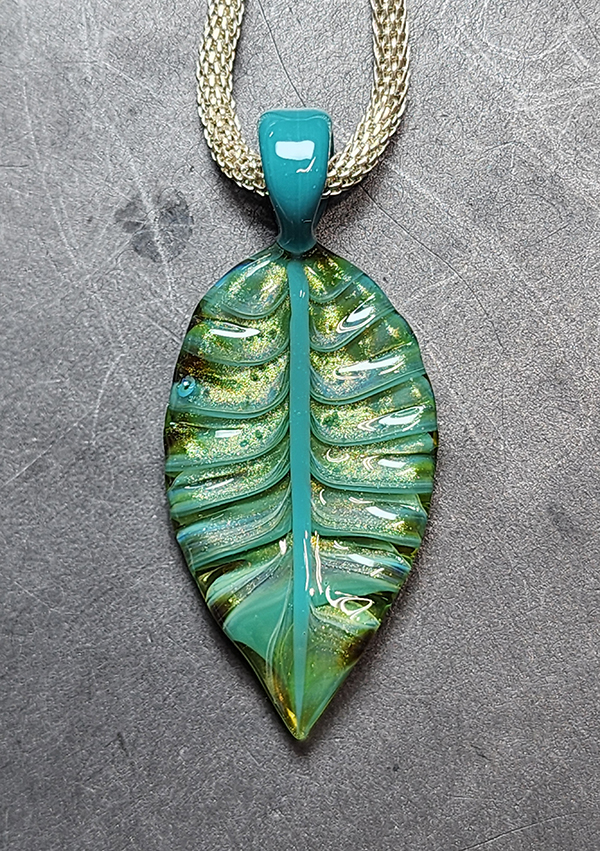
April/May 2026 - Vol. 39, No. 6.
|
In This Issue
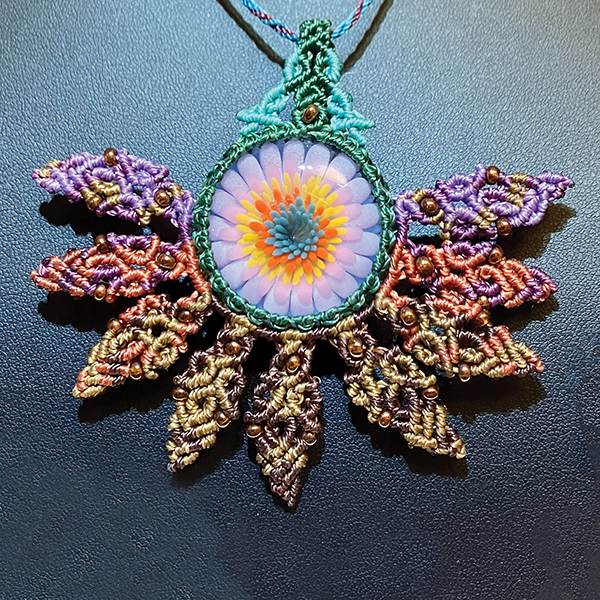
Dot Stack Pendant with Macramé by Juri Ohno
I incorporate various motifs into my creations, such as aliens with –Space glass, eyeball imagery, and botanical elements. My latest work involves integrating macramé with dot-stack glass. For the last three years, I have been studying the art of macramé, taking the time to refine my skills and evolve my style ...
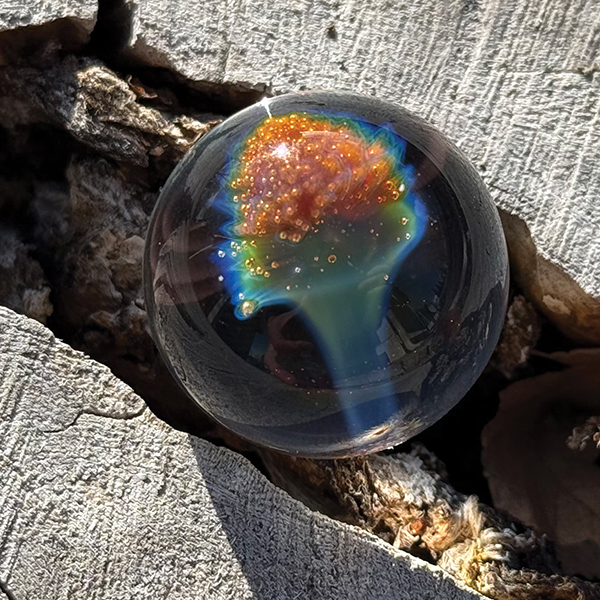
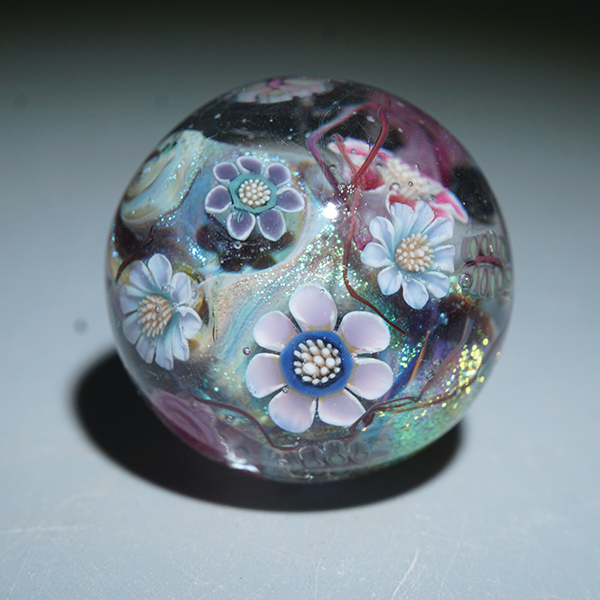
Splatter-Technique Marble by James McKillips
I started working with glass at a time when learning was mostly in person and information wasn’t widely shared. Early on, I worked wherever I could, renting bench space, sharing studios, and stepping away at times when access wasn’t possible. Progress came slowly, through repetition, observation, and time at the bench. A background in martial arts influenced staying stubborn about learning the process: showing up consistently, paying attention, and learning through failures and successes ...

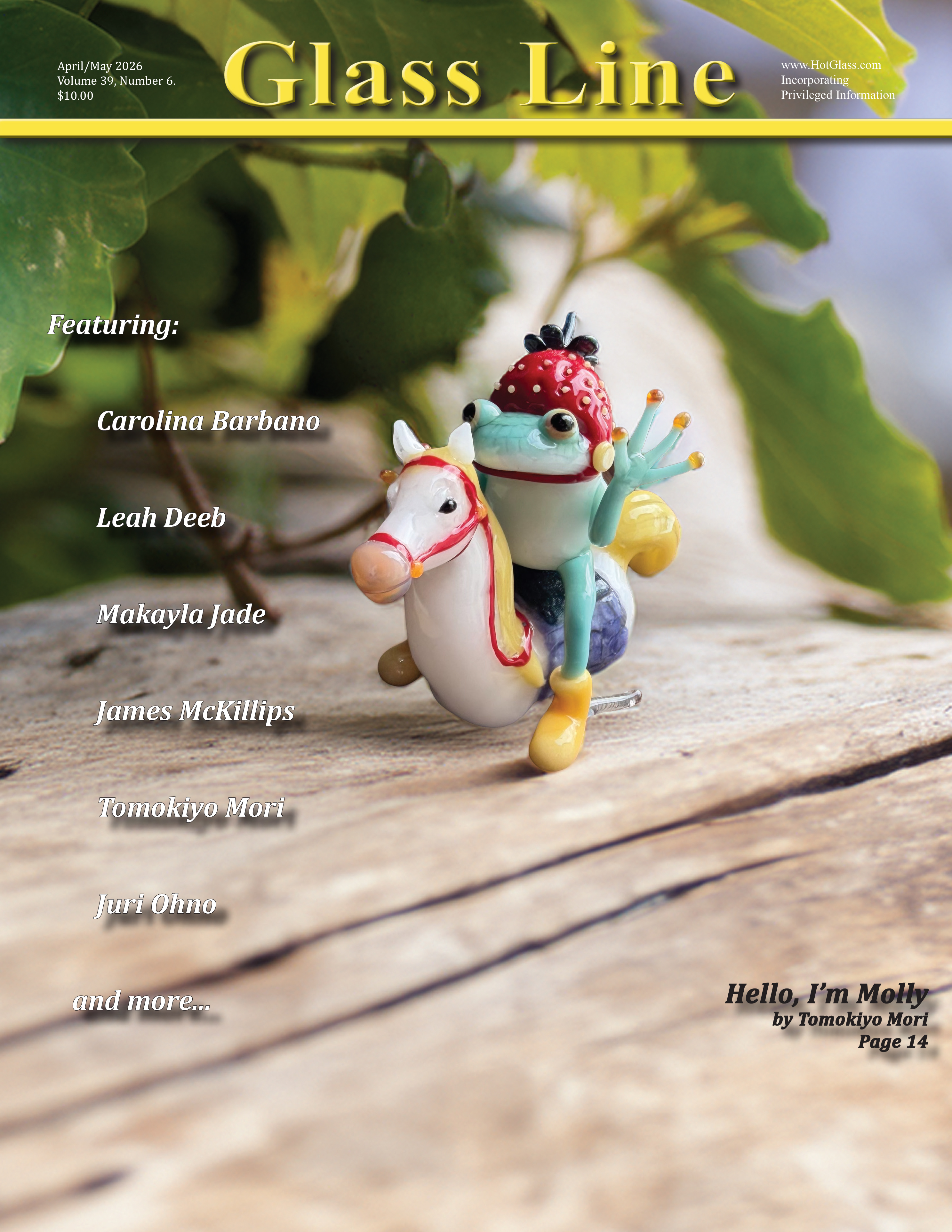
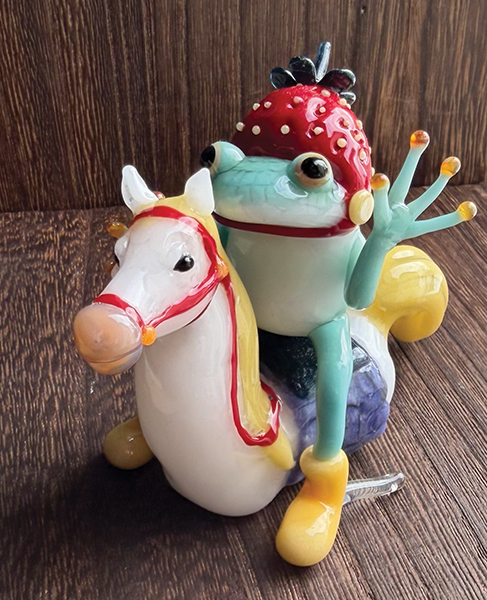
I consider the story, the background in which the characters live, the seasons, and the color palette. I also pay close attention to charming gestures, especially the positioning of the fingers and the eyes, to bring life and personality into the piece.
The production process consists of two stages. Since the frog must sit securely on the horse, create the horse first and then the frog to adjust the seating space and the length of the legs ...

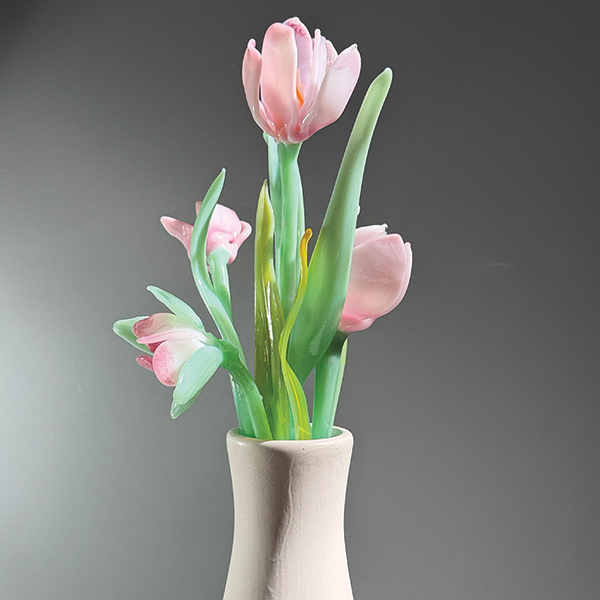
My glass flowers are often inspired by my time around the garden. I could say that I’m a frustrated gardener dealing with Las Vegas weather. Still, I’m always looking for opportunities to grow flowers. There’s something therapeutic about caring for plants … watching seasons come and go, and observing the tiny creatures that make my backyard their home. Lately, I have focused on tulips, ladybugs, and bees. I recently bought beautiful potted tulips that looked absolutely gorgeous for about two days, and then became very droopy and sad. I know soft glass is fragile, but I’m certain my glass tulips will last much longer.
Gardening and glasswork share more than you’d think. Both require patience; something I lack. Maybe this is why I enjoy both activities so much; they test my patience at every turn, and also my ability to let go (when plants perish or the glass cracks in the kiln). Both require an understanding of timing and an acceptance that not everything will go as planned.
Working with soft glass in the 104 COE range feels like the right medium for botanical work. The material has a fluidity and responsiveness that matches the organic forms I’m trying to capture ...

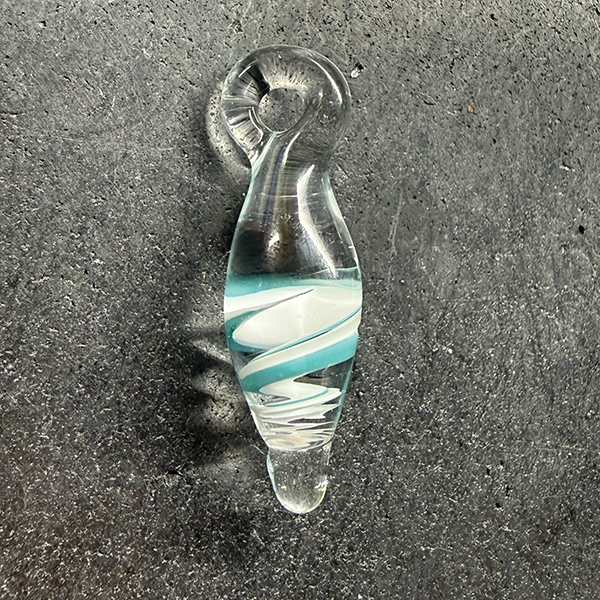
My name is Makayla Jade, and glass has become my life. While I often return to making familiar pieces, I also love to create new things. I seek out challenges, and glass never fails to provide them. One of the most valuable lessons I’ve learned through glassblowing is patience — patience with myself, with the glass, and with time.
Among the familiar pieces I tend to come back to are these swirl pendants; one of the first things I learned when I started blowing glass. I love how simple yet eye-catching they are, and how so many color combinations can be applied. There are a lot of small skills with this process that help create a solid foundation with understanding how the glass moves, how much heat to apply, how to keep air from getting trapped, and shaping solid ...

Now, after 18 years of melting, I have a very full glass studio that is my happy place. I also have a jeweler’s bench and do a lot of metal work, creating components and jewelry.
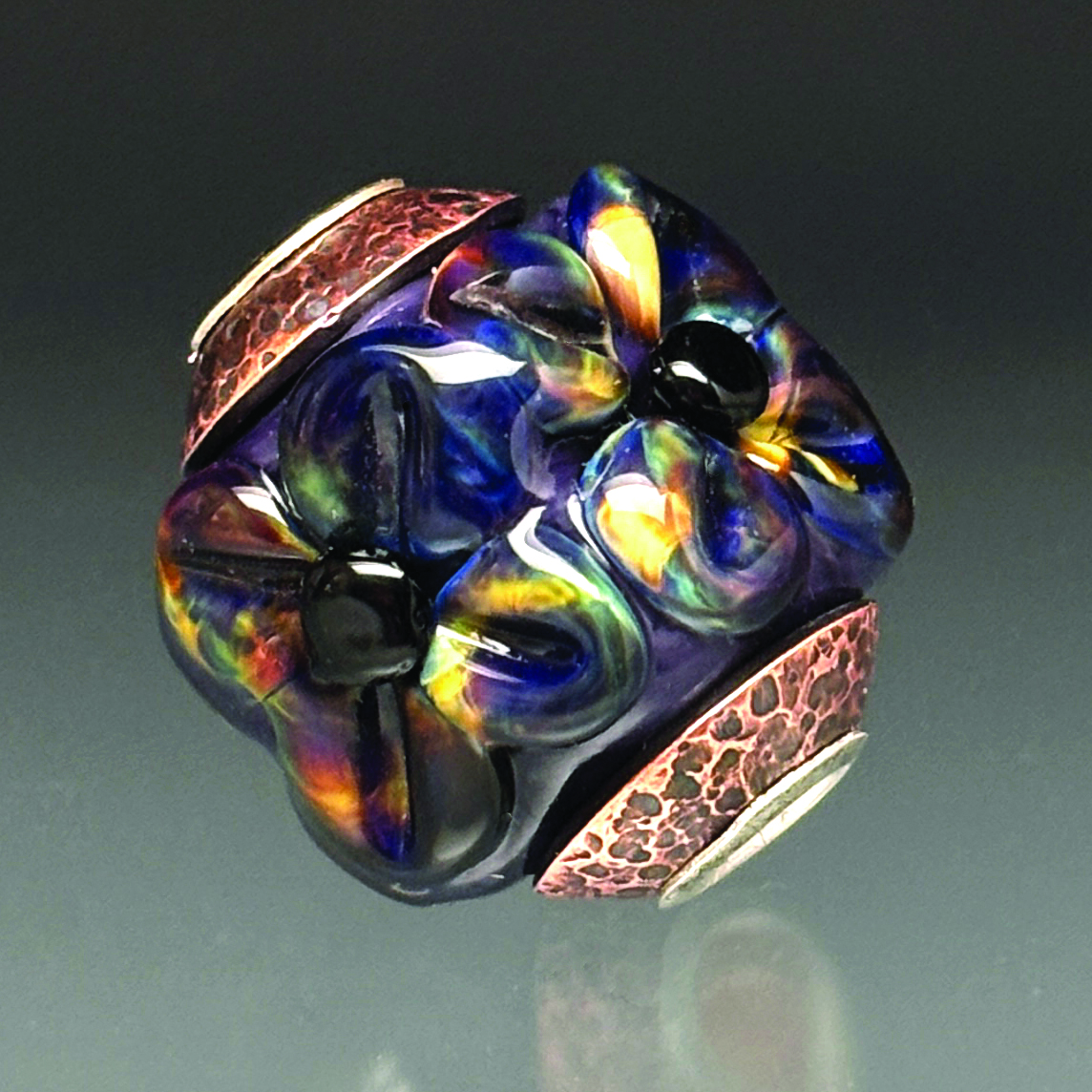
My heart and soul are with pieces that have an old world, vintage look — as if they were excavated treasures. That is where it all began for me.
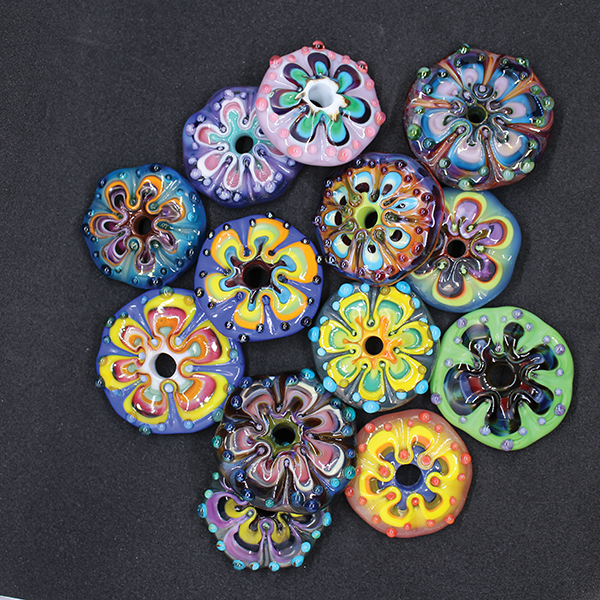
The very first Flower Power bead I made was in 2008. Since then, I’ve made many styles with many different glasses. I love creating them on larger mandrels and dressing them up with my handmade metal bead caps ...
|
February/March 2026 - Vol. 39, No. 5.
|
In This Issue
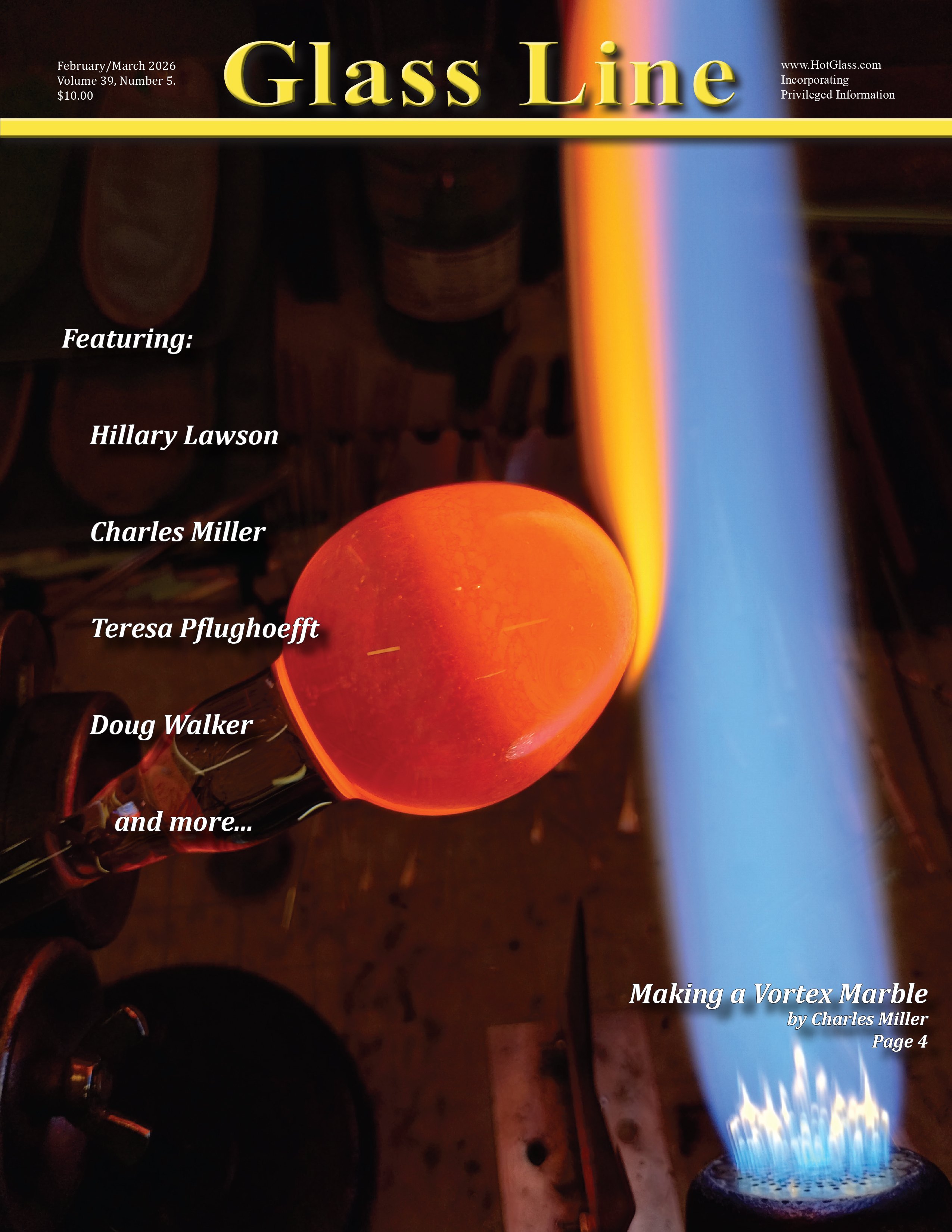
Making a Vortex Marble by Charles Miller
I found my stride in sculpting and mixed media; from alien sea creatures to what appeared as unearthed totems, using crushed glass “frit” as my main glass medium and palette.
Electroforming gave me the opportunity to explore new ideas, incorporating materials like leather, chain, bone, doll parts, barbed wire, bullet shells, etc., to my darker artwork.
If I had to choose a favorite tool, it would be a butter knife. Of all the sculpting tools I have used over the years, a butter knife has been my go-to. Not too sharp, not too thin, and can take the heat.
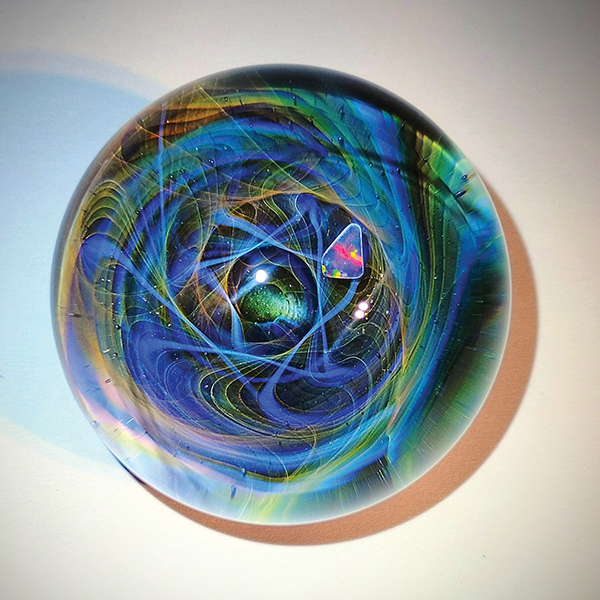
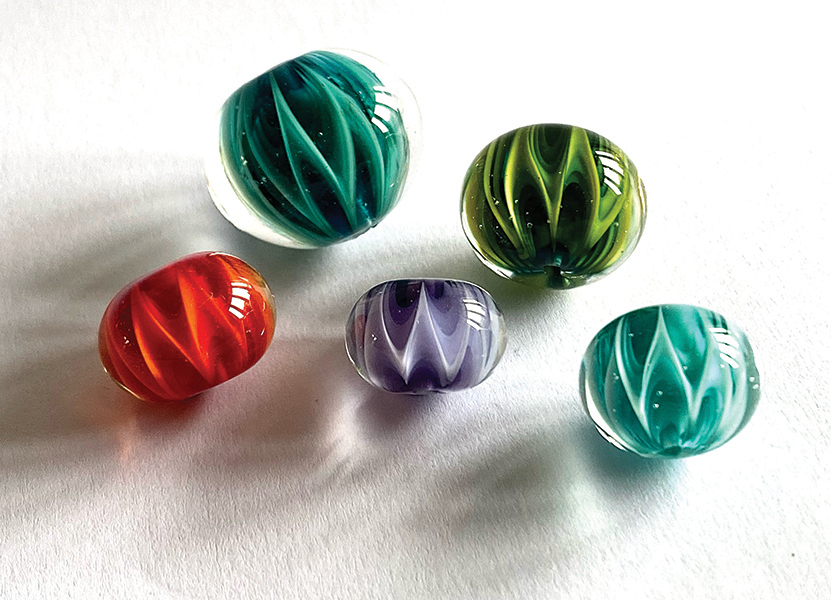
Marbles have been a big part of my recent studies, and it has been truly rewarding — pushing myself to new dimensions in space exploring vortex and fume work ...

I did extensive research about how to get started and began my new-found journey into glassblowing. My son Kyle and I started turning my garage into a glass studio. It has gone through many changes from the first time I started and is still forever changing. I ordered my kiln and went to Calgary with Kyle to get all the necessary supplies. I ordered tools from Puffs out in Vancouver, BC, and Artistry Glass in Ontario.
Over the years of becoming better with practice, I manufacture some of the tools I use today myself ...

No matter how many pieces I make, there is always a new challenging idea to try.
I always used to create jewelry. Connecting lampwork creations to metal works or bead weaving skills, along with working glass beads into fabric, can bring wonderful results.
I grow my own vegetables and keep my own chickens, so I spend a lot of time outside. In my glass works, I use a lot of leaves, flowers, animals, and other forms inspired by nature. For me, there is nothing more beautiful than seeing life unfolding, thriving, growing.
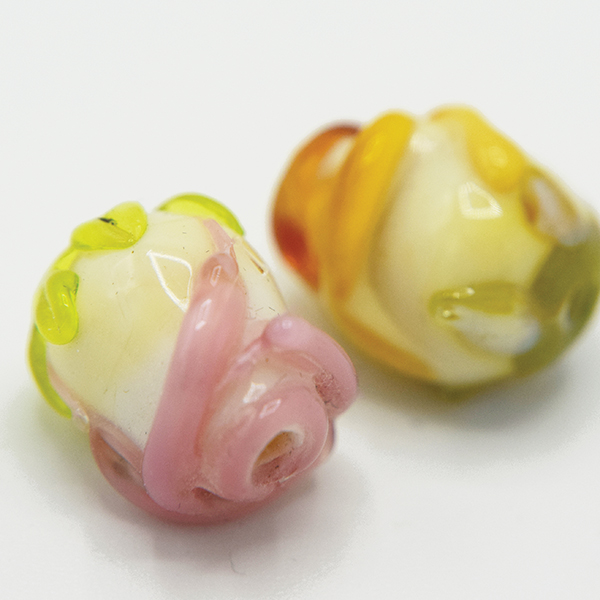
With Valentine’s Day coming up, I decided to provide instruction for a very simple rosebud — a rose that is just about to open, not unfolded yet. It is so simple that it is possible to make it very small. At times, I find small works very handy for building up bunches or smaller jewelry like earrings ...

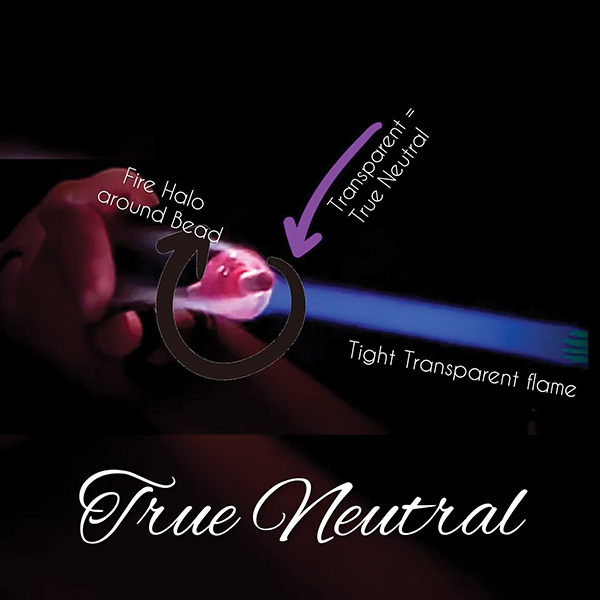
In lampworking, flame chemistry is not an abstract concept — it is a language. Every adjustment of oxygen and propane changes how glass behaves, how color develops, and whether a surface reveals its full potential or quietly collapses into flat, muddy reactions. When working with Double Helix glass in particular, learning to read and control a true neutral flame is foundational.
Through years of testing Double Helix glass, I have learned that predictable color is not achieved through rigid torch settings or borrowed formulas, but through visual fluency — learning to read the flame and the cues the glass provides in response. Flame chemistry becomes less about numbers and more about observation, timing, and intention.
This article outlines a practical approach to understanding flame chemistry through controlled observation, with a focus on proper resets, zero glow timing, and the identification of a true neutral flame ...
|
December/January 2025/26 - Vol. 39, No. 4.
|
In This Issue
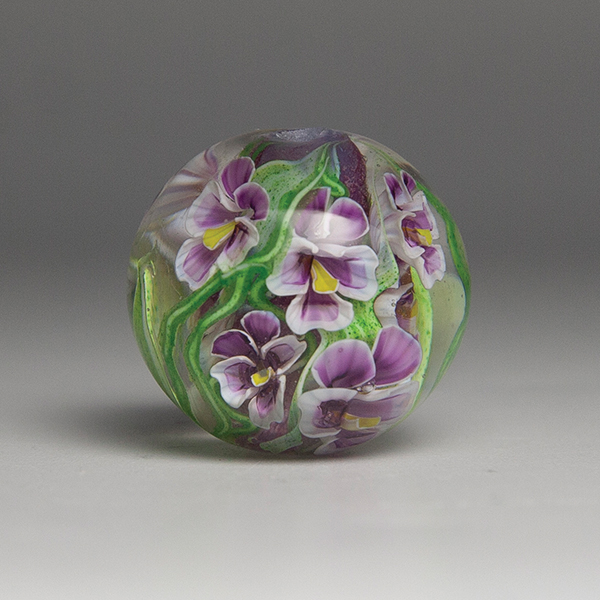
Pansy Flower Murrine by Daria Grigorieva
Since then, I’ve been learning from Russian artists and developing my own techniques. Murrine-making has always fascinated me — the precision, layering, and patience it requires resonate deeply with me. A major turning point in my journey came in 2019, when Toshiki Uchida visited Russia. His approach to glass completely changed the way I saw murrine and helped me grow as an artist.
This tutorial focuses on my pansy flower murrine. I first created this design a few years ago, at the request of a collector who specializes in glass art featuring pansy motifs. Since then, I’ve refined and adjusted the process, and it remains one of my favorite flowers to make. Pansies come in a wide variety of colors, so feel free to experiment and create personal combinations. My version leans toward violet tones, but the beauty of this flower is its versatility...

Two things I love are water and glass. I love the way the light shines through them in different colors (all shades of blue). One day in 2008, I was at a craft market in Maine and saw a stand that had lampworked glass jewelry. I spent almost the whole day there and went back the next day. I was mesmerized. A few months later, at home in Ottawa, I saw a night class at a rec center for lampworking. I was hooked. As an IT person, I love the science of working with glass and as a creative nature loving person I love the art and colors. I call my work “organic” because I really like that style, and I don’t have to be too precise. (I’m too impatient!)
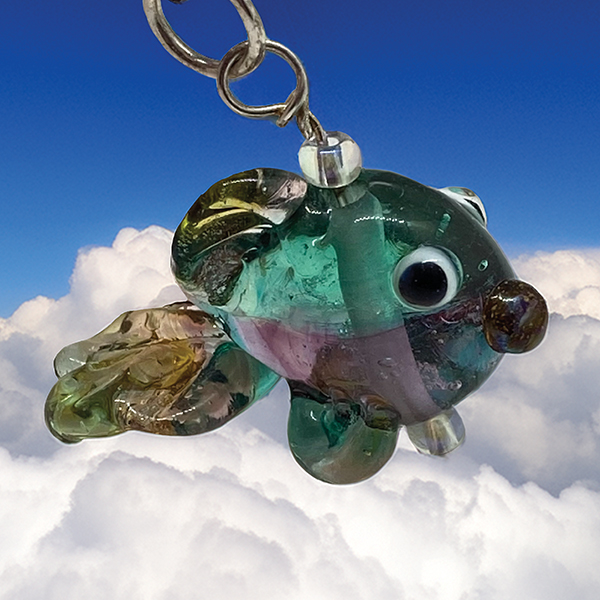
I love blue — most of my beads look like the ocean, and, being a Pisces, I started making fish. I’ve seen lots of different kinds of fish beads, but I like mine to look pretty and ethereal while cute and whimsical at the same time...

I didn’t use much murrine in my other work until I asked my brother, “How do you get such nice clean images every time?” and he told me how to do the Stick & Snap technique. I thought I’d explain that, too, as a little tutorial within this tutorial...
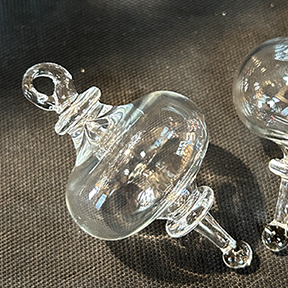
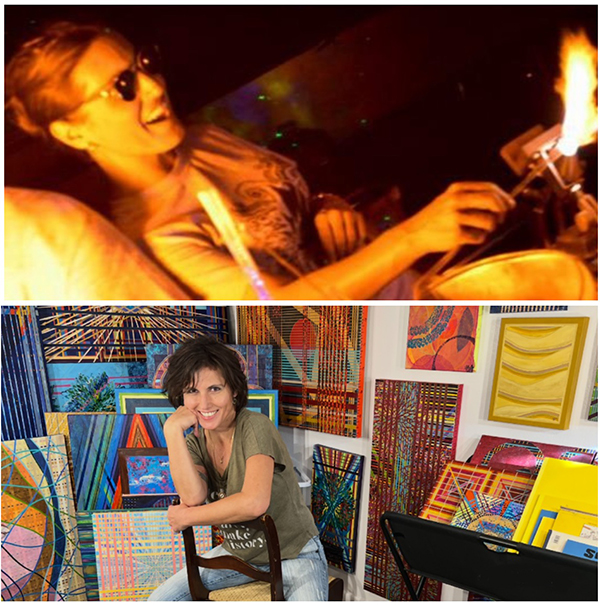
A lot of my glass projects consist of line work, montage, incalmo, and patterns. I also love working with clear glass. I’ve always been a visual person — vistas, optical illusions, anime, and sci-fi being sources of inspiration. I love making ornaments, cups, marbles, beads, pipes, jars, etc. I hand-make a lot of my own tubing, consisting of either fumed silver and gold lines or solid color patterns made with borosilicate color rods and encased in clear borosilicate. I break down this tubing into sections, then put them back together to create the forms. My goals now are to continue to make glass art and someday be able to teach these skills to future flameworkers and keep the tradition alive.
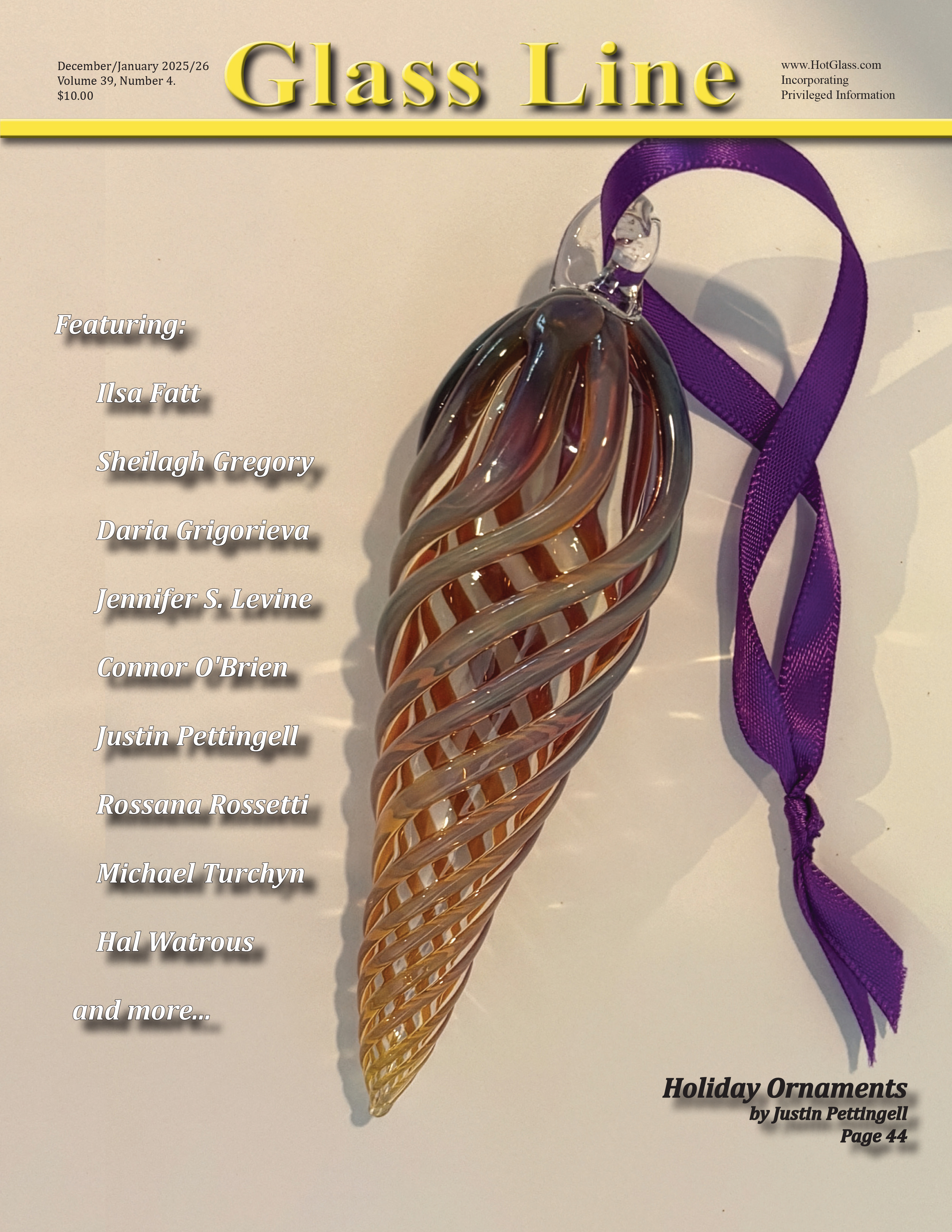
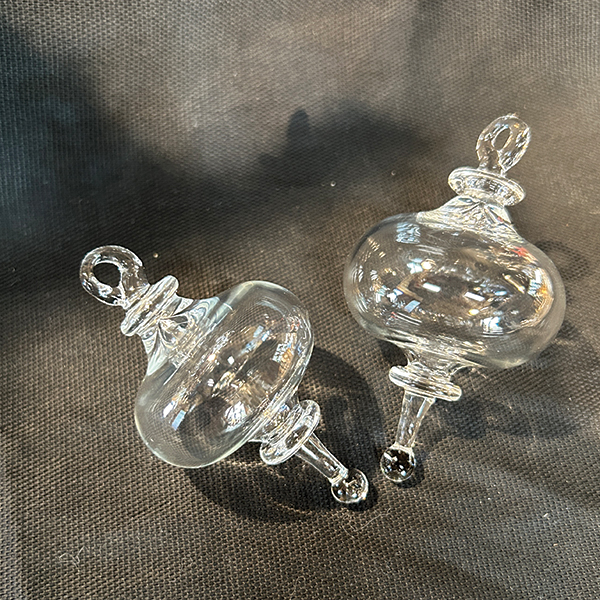
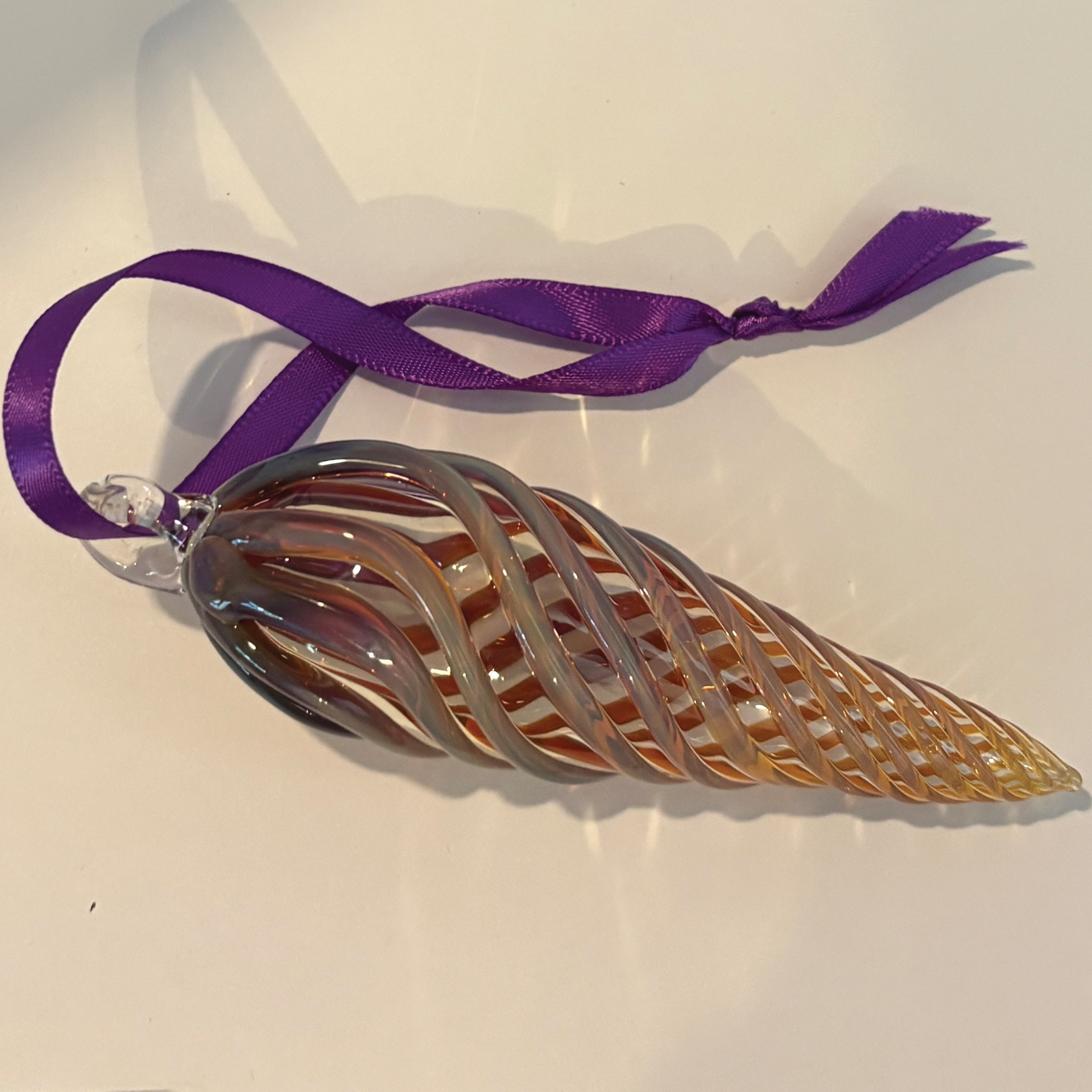
I’ve always loved making ornaments — they were some of the first objects I was taught to make in glass. They have turned out to be a great gift through the years during the holidays. I like to give mine an “oldy worldy” feel. This tutorial explores a clear hollow ornament using borosilicate glass. Any color, or size can be used to create an ornament. With the glass available nowadays, the possibilities are endless...

A key element is the integration between lampworking and enamel finishing — a mixed technique that I use at times to make refined finishes and overcome the glass process limits.
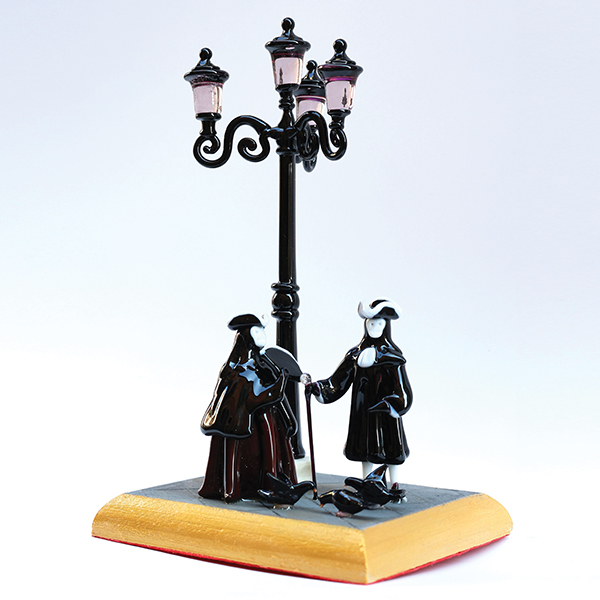
My workshop offer a variety of items: insect, cats, seagulls, pigeons, plague doctors (Venetian masks), musicians, sportsmen, soldiers and cavalry soldiers, fountains, street lamps, Venetian courting couples of the 17th century, as well as items made on commission.
Real subjects, antique painting, and drawings are my passion and my true inspiration, which may have been conveyed to me by my paternal grandfather. He was a painter and restorer at Pinacoteca Di Brera for many years...

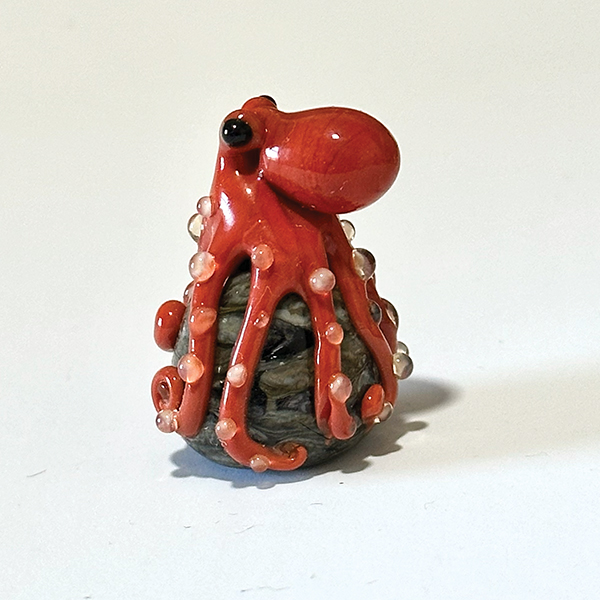
This tutorial is for a mini octopus figurine built at the end of a mandrel. It can act as a stepping stone for beadmakers who would like to explore sculptural work but are not ready to deal with the challenges of working off-mandrel. It can be made equally well off-mandrel. My version uses soft glass, but it would work perfectly in boro, too...

This tutorial shows how to apply silver coin vapor onto the surface of a blank of borosilicate, which I call surface application. It includes how to bake in the fumework on a Bethlehem Champion, which is a similar flame chemistry to the Nortel models I started off on. There is a subtle difference in application pertaining to the shape of the flame. It will also show how to form classic icicles with solid color rod.
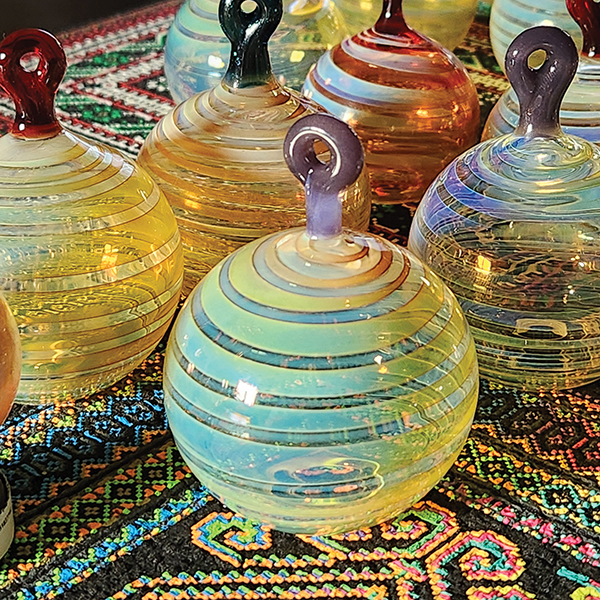
One of the biggest inspirations to my life’s work and style is traditional ornaments of old and other forgotten Americana — I am fighting to preserve a piece of a tradition, and I enjoy being the “Christmas ball man of Christmastown USA.” I am always going to keep my work as old-fashioned and resilient as possible, with the goal being to create a bomb-proof piece of fumed artwork that can be passed down like an heirloom, and with my ornaments being signed and numbered...

by Jennifer S. Levine
Artists are social commentators of the times. We highlight, we underscore community and cultural interests in the themes of our work, be it natural or abstract form. The tools we use speak to modern technology, be it innovations in materials and practices or carrying on the traditions of age-old craftsmanship. Everything we create is a voice of our generation. With all that being said, how do we keep up and standout in the cacophony that is today’s society, much less the marketplace...

In 2021, I eventually built a new studio at the Mechanicsburg Art Center and began teaching glass classes there. In 2023, my mother, a family friend, and I opened a studio at Millworks in Harrisburg, Penn. We work on collaborative projects, combining paper mâché, clay, glass, wood, resin, dirt, plants, and anything else that looks cool to make immersive environments focused on mythical and fantasy/sci-fi-themed creatures and their dwellings and surroundings.
Most of my sales in the glass art world are holiday ornaments. I make nearly 1,000 between September and January every year and ship them internationally. The process in this tutorial has taken eight years to develop and is forever being modified and improved...
|
October/November 2025 - Vol. 39, No. 3.
|
In This Issue
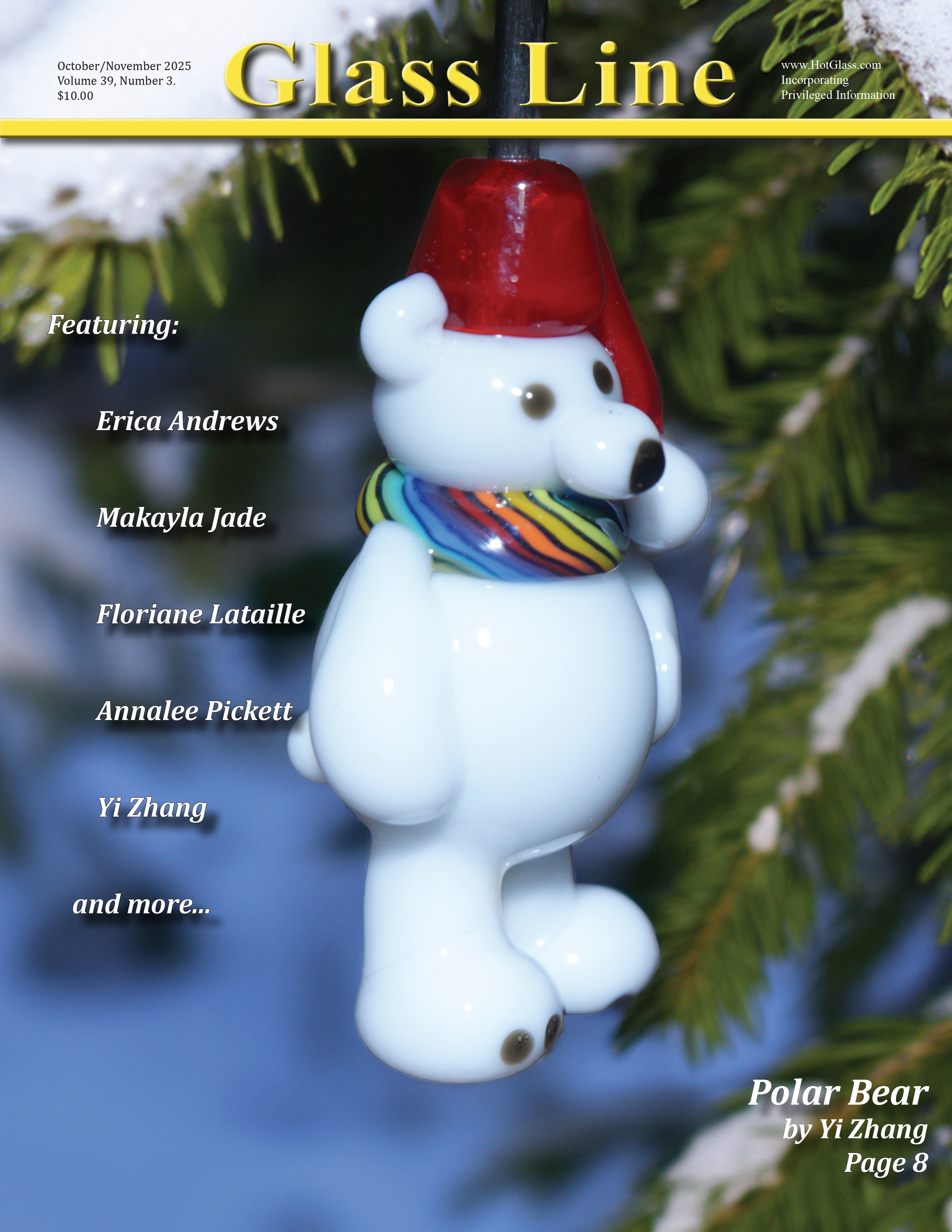
Wig-Wag Glass Bead by Floriane Lataille
I teach a lot, trying to pass on my passion for this profession and this magical material that is glass. The gamble seems to have paid off: Many new enthusiasts have joined the community.
Teaching is a pleasure and a real exchange. Through their questions, their fresh perspective, and their different point of view, my students help me understand glass better, try new things, but also go back to basics. It’s a real boost for creativity.
The strength of our profession lies in the kindness and sharing that characterize the community of flameworkers. It is so precious, so let’s take care of it ...

This year, I made much progress in my lampwork career. I published several articles and was a finalist for Bead for Venice.
Last year was also crucial for me to start my spiritual journey. I spent a lot of time meditating and walking in the woods alone. It sparks lots of fun inspiration. Everything in life — a book, a song, a poem, a vision, a dream — can become an inspiration of my daily art creation. When creating with glass, I can dip myself in the flow. It enlightens me in every aspect of life. Some of my customers tell me they can feel the love energy from my work. Lately, I find in my world that science, art, and spiritual just come together as a whole. It makes me understand that technical, artistic, and inspirational are all equally important in glass creation. They are all parts of human nature, too, and never separated ...

I’ve been fortunate to study with some of the best lampworkers in the country — artists like Tim Drier, Julie Riggs, Robert Mickelson, Bandhu Dunham, Deb Drowley, and many more, through multiple trips to the Art Glass Invitational in Pennsylvania. The experience of learning alongside so many talented makers deepened my skills and fueled my passion for collaboration.
Around the same time, I became involved in helping launch Spark Makerspace in New London, Connecticut, a nonprofit dedicated to sharing tools, knowledge, and community. Today, 10 years later, Spark is thriving, and I’m proud to still serve on its board of directors. Even though we don’t have a lampworking studio (yet!), I love knowing that others can explore woodworking, printmaking, stained glass, and more, without needing to own every tool themselves.
Making, creating, and learning are at the core of who I am. After 12 years, glass still surprises and challenges me, and I know I’ve only just scratched the surface of what’s possible. The road ahead is full of discovery, and I can’t wait to see where the flame takes me next.
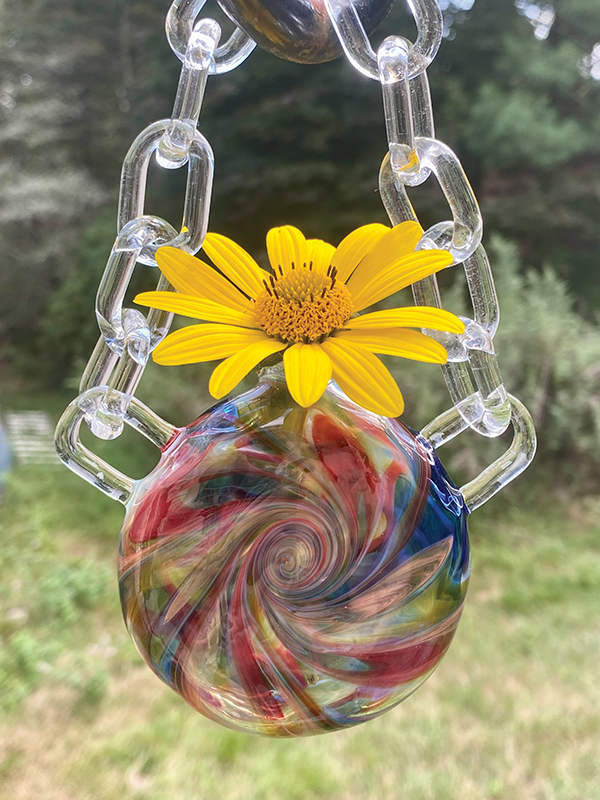
This tutorial explains how to make a glass vase suncatcher with a glass chain using a wrap-and-rake technique ...

While I was still in trade school, I reached out to that family friend and asked if he’d be willing to teach me how to blow glass. He said yes and everything changed.
At first, I took lessons here and there, just getting familiar with the torch and learning how the glass moves. From the very beginning, I was hooked. Glassblowing captured everything I loved. It kept my hands moving, challenged my brain, and reconnected me to my creativity. Every piece felt like a new exploration, and the possibilities were endless.
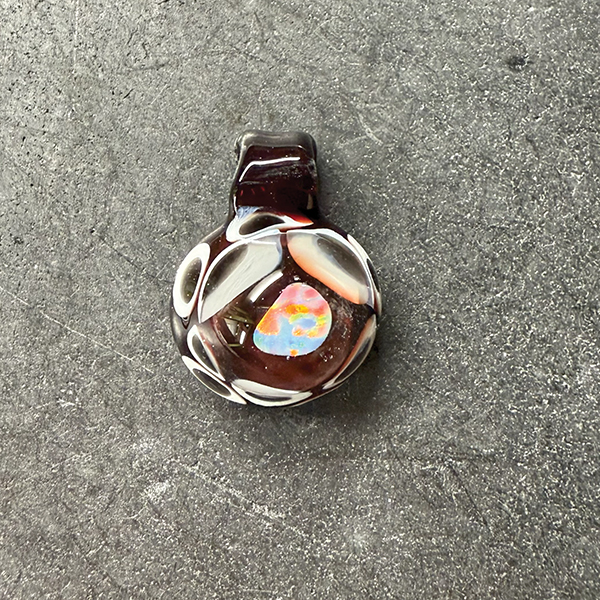
Eventually, I moved into a new studio space and started taking things more seriously. I began making opal drop pendants that sparked new ideas and helped me build confidence at the torch. From there, I learned new techniques, experimented with color patterns, and continued to push myself farther.
One of the best parts of this journey has been discovering the local glassblowing community. They’re incredibly supportive, and they’ve played a huge role in helping me grow. Today, I specialize in dot stack designs, mostly pipes and pendants, but I always come back to opal pendants. They’re where everything began.
What started as a side hobby has grown into a true passion — a blend of craft, creativity, and connection. Glass gives me the challenge I crave, the artistry I missed, and a medium that continues to surprise me every time I light the torch...

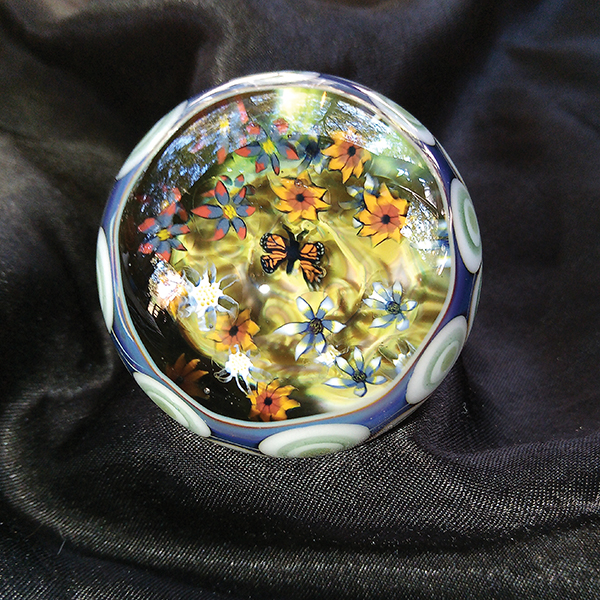
This paperweight tutorial is meant for people who have moderate experience with soft glass and access to a kiln capable of running long cycles. The inclusions and tools here are simple, but many steps and supplies are needed.
While there are several ways to make paperweights, this project focuses on encasing soft-glass lampwork inclusions at the bench. An important tool is the Stump Sucker (SS), which allows the molten glass to be pulled around the inclusion through suction. The Stump Sucker is milled out of carbon; what might be found in a hot shop would be metal and possibly custom-made.
This SS is modified slightly with a threaded steel tube; the same thread as the SS port, which is 3/8”. This tube allows the SS to become very hot but not burn the vacuum hose. The steel tube is about 10” long.
The inclusions are heated before being encased, with a Bunsen burner underneath the SS. The setup should be secure before starting, and safety should always be the top priority when working with hot glass and open flame. The kiln should be on a fire-safe surface with ventilation running while prepping and heating...
|
Augusts/September 2025 - Vol. 39, No. 2.
|
In This Issue
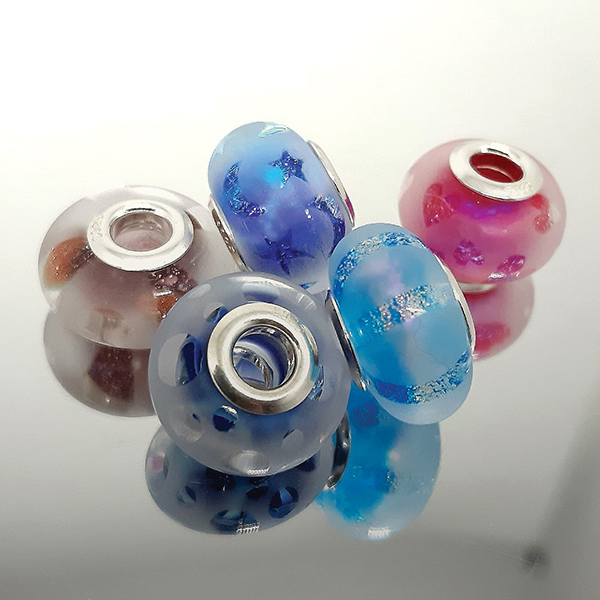
Stars in Transparency by Luisa Vetuschi
Since I was a child, my hands have never stopped, I was attracted by everything that was done manually. Over the years, I have experimented with various types of processing and with very different materials. The important thing was to see something born from my hands. In 2017, I attended a course to learn the basics of glass lampworking and then I continued to be self-taught to be able to create with the techniques that most interested me...

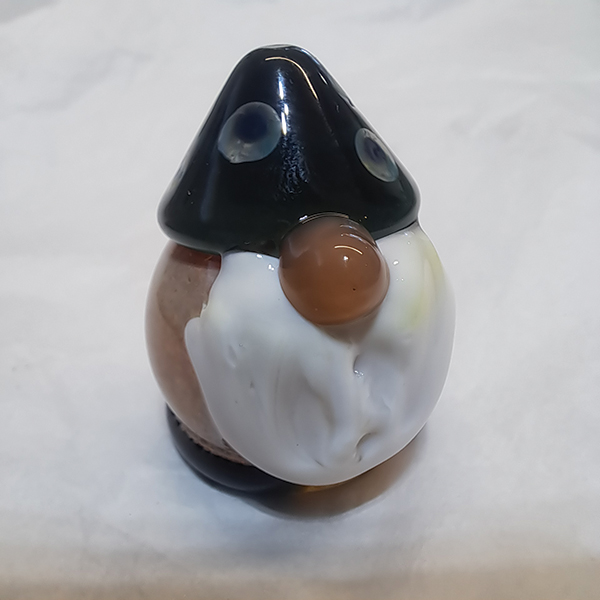
This simple gnome sculpture is designed to sit flat on a table. It can get much more creative with the addition of arms, fancier shoes, and more color combinations, but the simplicity of this design means it can be made in less than 10 minutes. Using frit for the body color decreases the time and makes it less expensive in materials. If making 10 of them in a row, I switch up the body color every couple of gnomes for some variety.
I‘ll use different colors for different seasons or even different sports teams. People usually like to get items with colors from the local college team and gnomes are an easy way to draw some sports fans to a table. They can also be paired with sculpted mushrooms or people can mix and match a few of them for a deal...

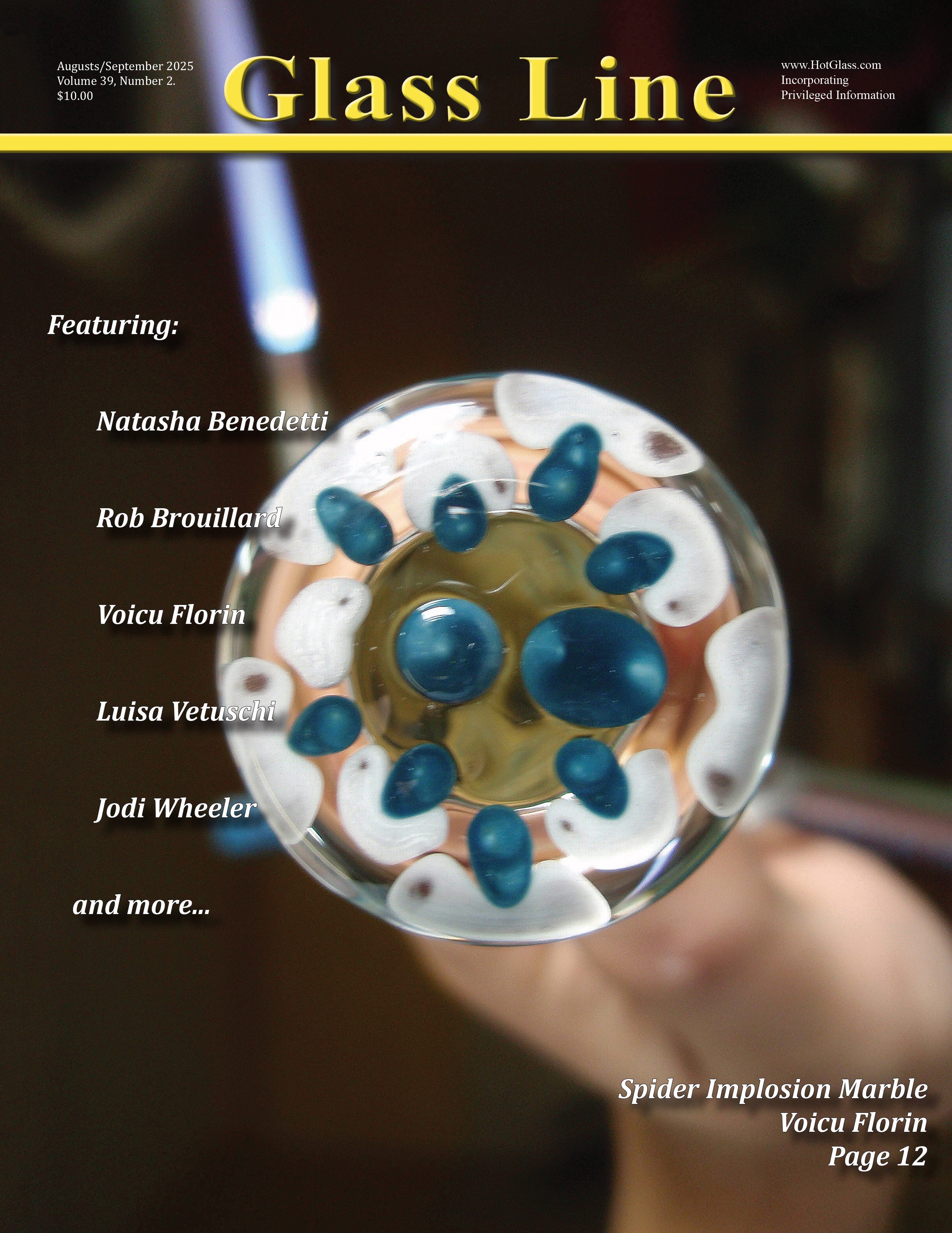
I am always thinking about making something that has never been done before. I came up with this design while I was cleaning the attic for my new and improved workshop, so I cannot say that no spiders were harmed, but they made a good source of inspiration.
If you are not familiar with implosions, start with simpler designs before moving on to this one...
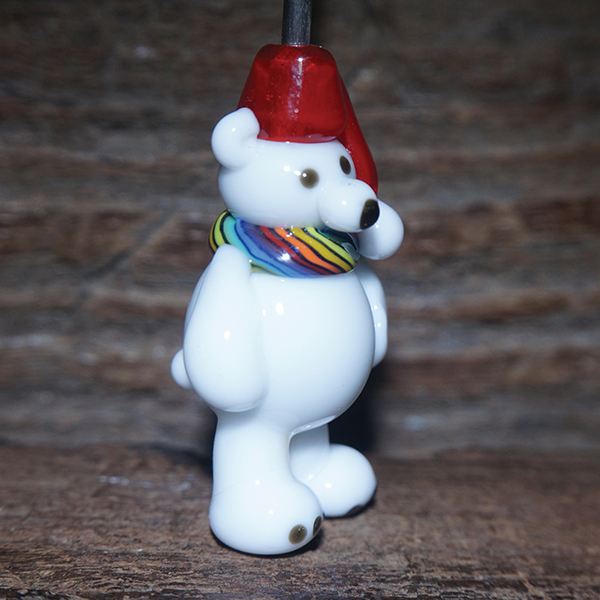
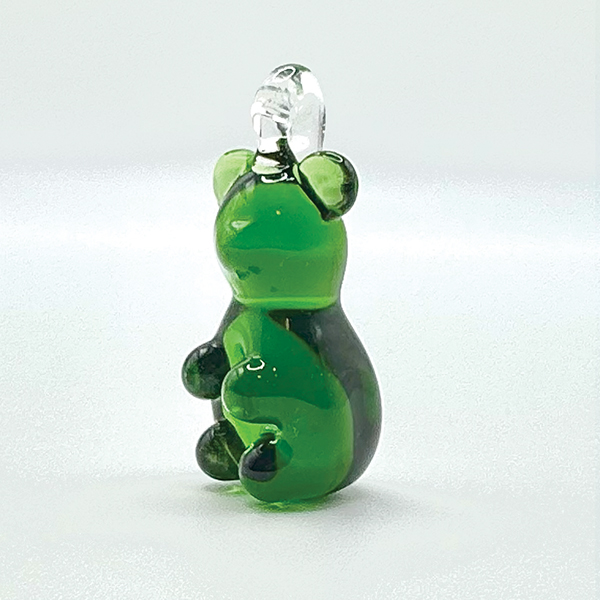
Gummy Bear Pendant by Natasha Benedetti
I use glass to mimic and imitate all the tangible objects around me. I have started to view life through an artistic lens and am constantly thinking about how to create things with glass. I am inspired by nature, food, people, and society. To add a playful element, I tend to gravitate toward pastel colors. The sculpting process — constantly shifting between liquid and solid — intrigues me. I try to create everything from hollow forms to solid sculptures...

I am currently a high school and college math educator of calculus and pre-calculus, but looking forward to retirement from teaching mathematics and having the opportunity to spend more time teaching glass bead- and jewelry-making.
All of us in the beadmaking scene have this same problem: shorts. So many bits of glass, too valuable to toss, too short to use without burning our fingers. I save all my shorts in a little paper bag and use them on various Scrap Day projects...
|
June/July 2025 - Vol. 39, No. 1.
|
In This Issue
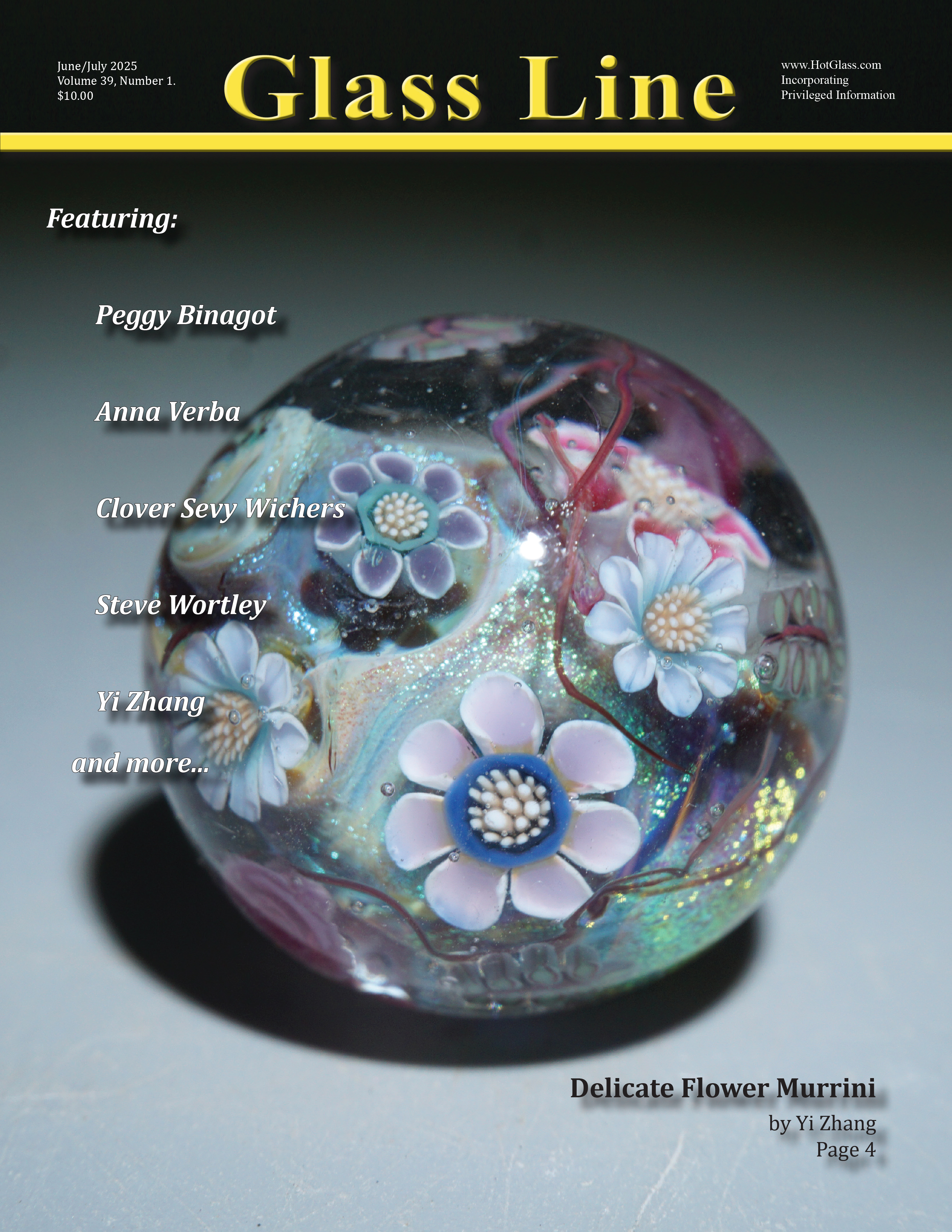
Delicate Flower Murrini by Yi Zhang
Some of my customers tell me they can feel the love energy in my work. I do find that science, art, and spiritual just come together as a whole. It made me understand that technical, artistic, and inspirational are all equally important in glass creation. They are all parts of human nature and never can be separated.
...

I first discovered the world of glass through my neighbor, Charlie Shoulders (@livingontheetch). I spent hours in his studio, watching him create the most marvelous things with glass rods and a torch. One day, I asked if there was any type of glass work he would like to do but couldn’t; his answer: “faceting!” Once he explained what that meant, I got started on a jig to use next to his 12” Crystal Master lap grinder. My first result was quick but hard to use. I kept refining the design, and 18 months later the LapDancer was born. In 2018, it was introduced to the world at the Michigan Glass Project.
My approach to build a faceting jig was unique enough that I was awarded a patent for the design in 2022 (image a).
That brings up the topic of the LapDancer vs. everything else. I created the LapDancer to solve a problem for a friend, and with no knowledge of other devices. The solution I arrived at was significantly less expenisve to build than other approaches, but was fairly similar in function to the existing machines. There is one exception, however...

I’m from Brittany in France. As far as I can remember, I’ve always been creative; I did all sort of crafts. When I was a little girl, my mum offered me a trade bead. I was fascinated by this glass bead and I tried to understand how it was made until 2017, when I had the opportunity to participate to a two-day lampwork initiation glass workshop and the mystery was revealed.
I didn’t practiced this art regularly until 2021 then. Since, I’ve taken some workshops to perfect myself and I’ve just started my small enterprise.
This tutorial uses the off-mandrel technique...

Art and creativity have always fascinated me. I graduated from the university with a degree in ceramic art. We drew a lot of graphics, painting, sculpting from clay, tried wood carving and fabric painting. I got to know glass in my freshman year at the institute. A friend gave me a master class for my birthday, and I really fell in love with glass.
I’ve been making glass art for 13 years now. I mostly use Effetre Moretti soft glass in my work, as well as Double Helix. I like to create sculptural beads in the form of animals: birds, bunnies, hedgehogs, owls, whales and fish, and more...

I began exploring small-scale glass sculptures in my jewelry designs. I liked to create pendants of female torsos, hands, feet, and faces. I wanted to take my two-dimensional background in painting the female form and people, and reflect it three-dimensionally in my glass work.
A few years ago, I moved from Colorado to Washington. During this time, I didn’t have a workshop for much longer than planned. I took up ceramics to continue the sculptural ideas that were rolling around my head and occupy my restless hands. The subject was still the female form. It was also at this time that I started researching glass kiln casting. I enjoy ceramics but, in my mind, I always looked at all of it as if it was glass, and that it would eventually be glass.
I finally built my new workshop and I’ve thrown myself back into glass full tilt. This time around, I am experimenting with a mixed media glass version of my work. I’m back at the torch but I’m also learning as much as I can about kiln casting with lost wax casting and paté de verre. My focus right now is sculptural. I am very much in the middle of an exploration/merger with my work. I think of my varied past work as puzzle pieces that may look unrelated but are beginning to fit into each other. All the little pieces of me (professionally and personally) and what that means in my work. Like I said, no path is ever straight. Don’t be afraid to embrace change and see where it takes you...
|
 April/May, 2025 - Vol. 38, No. 6.
|